


We’re back - I hope you had a good summer and enjoyed some downtime with your friends and family. I thought I’d do something different this week and highlight stories that flew under the radar whilst everyone was away, as well as one story that broke overnight. It’s a pot pourri!
Today’s Long Read is an op-ed by Jeremy Thorburn, one of Europe’s leading AI innovators. I recently spent a day with Jeremy discussing AI and publishing, and he kept coming back to one question, “Yes, but what’s the business case?”
For many publishers, the potential of AI is almost unlimited, but it’s all too easy to lose sight of whether AI innovation adds to a publisher’s bottom line. So I asked Jeremy to lay it all out.
Brace yourselves…
How Much of The Internet is Written with AI?
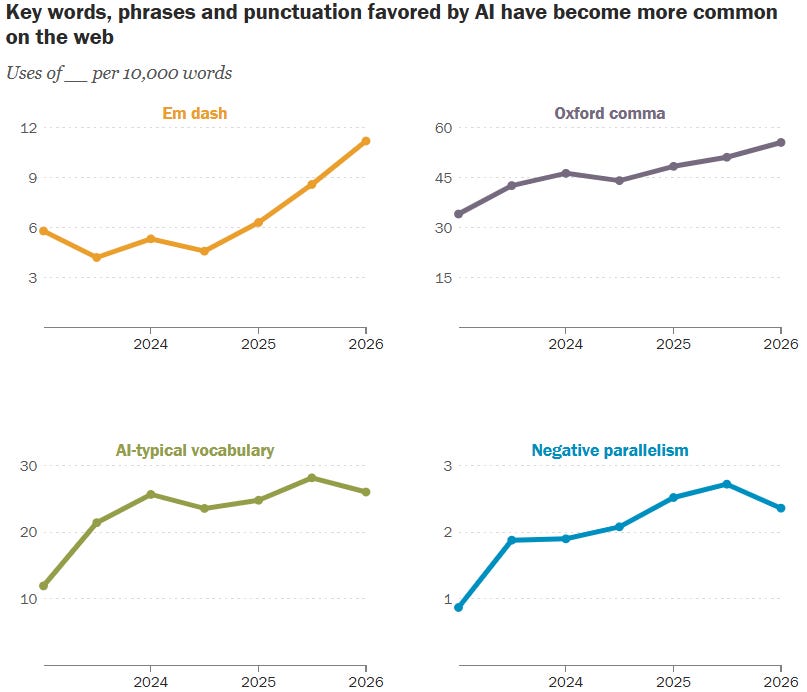
Pew Research used the Common Crawl web archive to collect half a million English-language webpages and ran them through Pangram. TL;DR: There are signs of AI authorship in over one-third of pages published since ChatGPT’s release in Nov 2022. Use of “negative parallelism” (“it’s not just X, it’s Y”) has tripled…
Over 1 Million People Have Clicked LinkedIn’s AI Slop Button
LinkedIn is clamping down on fully AI-written articles, which are estimated to make up 41% of all long form content published on the platform. It’s also removed its “enhance your post with AI” feature. Users are now seeing 40% fewer views of content LinkedIn identifies as AI slop…
A Hot New Contender to YouTube
Nine years ago I reluctantly published a story about a new platform called TikTok which I thought sounded ridiculous at the time. Not anymore. And here we go again - fresh out of China is Bilibili, a cool young YouTube rival from China with 380M monthly active users. Rob Corbidge writes, “That’s quite the kickstart.” Creators like MrBeast are already dipping their toes…
Breaking: Google Won’t Be Forced to Break Up Its Ads Business
Ricky Sutton takes a swipe at yesterday’s ruling which allows Google to retain its ad server, AdX exchange, the buy-side tools, and the data that flows between all three. In short, it retains its monopoly. Key quote: “Publishers across the world are telling me that they do not see a sustainable future in advertising on the open web. After this ruling, it looks like they’re right.” Yet the judge stated Google broke the law…*sigh* [News/Media Alliance statement here]
Rage Against the Machines: Structural Disruption is Not Decline
With organic clicks down 42% since Google’s AI Overviews rolled out, as well as numerous other ‘hits’ (e.g. LinkedIn reach down 50% YoY), publishers could be forgiven in thinking that media is dying. Tony Uphoff begs to differ, arguing we’re witnessing yet another era of structural disruption, not decline. Question: “Am I rebuilding for where the value moved, or defending the version that used to work?” #1995redux #2005redux etc

AI Authorship: It’s Getting Messy
When 73y/o billionaire Stanley Druckenmiller proudly penned an op-ed using AI for the Wall Street Journal, plaudits gushed for both writer and publication. Yet the Financial Times recently chastised Harvard Prof Ricardo Hausmann for doing exactly the same thing, adding an editor’s note. So who’s right? PubTech Radar’s Helen King offers a superb analysis with a clear conclusion…
Why SFGATE Launched an App Rather Than a Paywall
Hearst-owned local news site, SFGate, has kept its website free and instead launched an app for its most loyal readers. Coined ‘Friends of SFGate’, the paid app offers exclusive events, journalist meets, games, audio, etc. It’s only four weeks in but 90% of readers taking the seven-day free trial have converted to paying customers ($4.99/mth). The North Star metric is now repeat visits…
Judge Says Google/Publisher AI Situation “Seems Really Unfair”
Penske Media has moved a step forward in its licensing monopoly case against Google which accuses Mountain View of getting publisher content for free because no publisher can realistically walk away from search. EU regulators are simultaneously asking publishers about Google’s AI-search opt-out. No rulings yet, but if the AdX case is any guide, don’t hold your breath.
MSN Removing Publishers Without Notice
I’ve never been a Gates fan, but even by his standards this is poor > several independent publishers have been abruptly removed from MSN. Gadget Review, which received 50,000 daily page views from MSN in June, was unceremoniously dumped from the platform last month. TL;DR: MSN is focusing on premium media brands. MSN is currently the fifth biggest news website in the US…
Advertisers Could Soon Demand ‘Verified Clicks’
A report from Omnivery shows that email click metrics are being distorted by bots automatically checking links. The result? Advertisers are now demanding proof that publisher newsletter clicks are by real humans. Beehiiv is the most aggressive in filtering bots from metrics - “saving advertisers $14 million in ad spend” - whilst Gmail’s reputation is cratering as bot clicks surge from 2% to 20%.

AI Tool: Treg
Ignore the ghastly name, Treg gives ChatGPT or Claude access to SEO data (keywords, search rankings, backlinks, Google Analytics, Search Console and AI visibility data). In short, it allows AI to become your SEO right-hand man rather than jump between consoles. Pay as you go…
Event: INMA Media Tech & AI Week
Three days of study tour stops (including Hearst, OpenAI, Reddit, Cloudflare, AWS, Microsoft, Salesforce, & San Francisco Chronicle) are followed by two days of conference sessions. If you’ve got enough stamina, there’s also a cocktail evening. 19th-23rd Oct 2026 | San Francisco | $10,000 if you must ask…

In partnership with Bridged, WNIP has created Media Genie - a smarter way to explore 17 years of publishing insight. Ask a question about the media business and get a direct answer grounded in WNIP’s archive. 👇

You Are Budgeting for Tools Before You Have Priced the Problem
AI and automation earn their place. Here is the arithmetic that decides which do.

Every publishing business has a category of work that nobody planned, nobody budgeted for, and nobody can see on a P&L. It is the checking.
Somebody logs into the ad server each morning to see whether campaigns are pacing. Somebody pulls numbers into a spreadsheet at month end because three systems disagree. Somebody notices on a Thursday that a campaign is going to miss its guaranteed impressions, and the make-good conversation starts. None of that work appears in a job description, all of it is paid for.
I spent twenty years running operations, most recently as group COO of a services business across six countries, and the checking is the most reliable thing I find. It’s a different sector, but the problems are the same. Work that exists only because a system cannot tell a person when something has gone wrong.
It is also, conveniently, the easiest waste in a business to put a number against. Which matters, because you cannot confidently decide what to automate until you know what the current situation costs.
Start With What Is Actually Happening, Not the Process Map
The first mistake is to ask how the process is supposed to work; ask the staff what they did last week instead.
In practice this means sitting with the person doing the work and watching them. Ask them to talk you through the last month-end, what they do first thing on a Monday or what they check twice because they do not trust the number. That last question is usually the most productive one you will ask all week.
You are listening for three things:
Polling - Somebody looking at a system to find out whether anything has changed. Checking delivery pacing across live campaigns is polling. So is refreshing a dashboard.
Reconciliation - Somebody making two sources agree. Ad server vs the advertiser’s own numbers. Booked revenue vs delivered revenue vs invoiced revenue.
Re-keying - The same data typed into a second place. Campaign details from the insertion order into the ad server. Delivery numbers from a report into a client deck.
Each of these is a symptom of the same underlying problem: two systems that do not communicate, bridged by a person.
Cost It Properly, and Cost the Delay Separately
Now put a number on it. There are two components, and most people only count the first.
The labour. Hours per week multiplied by a fully loaded hourly rate, which is salary plus employer costs plus overhead.
Take an illustrative case. Two people spending five hours a week each on pacing checks, discrepancy chasing and report building. At a loaded rate of £40 an hour, that is £400 a week, or around £20,000 a year. Substitute your own figures, but be honest about the time. People consistently underestimate this, because the work is usually scattered in short blocks throughout the day.
The cost of finding out late. This is often the omitted piece, and it is usually the larger number.
Checking is not free even when it works, because checking is periodic and problems are not. If someone reviews pacing every morning, the average problem lives for half a day before anyone sees it. If the review happens weekly, the average problem lives three and a half days.
Now attach a consequence. A campaign that has fallen behind can be corrected cheaply in week one by widening targeting or adding placements. In the final week the only options left are expensive: a make-good, a credit, or over-delivering by taking inventory that another campaign needed. If that situation arises, say, six times a year, and the average cost of a late catch is £1,500 in make-goods and lost inventory, that is £9,000 a year attributable purely to detection lag, not to the underlying problem.
Again, use your own numbers. The point is the structure: Labour plus delay. Many businesses count the first and are baffled that automating it did not deliver what they expected.
Rank Before You Build
By now you will have found more than one of these. Do the same sum for every piece of checking on your list, then rank them by what each costs you a year.
The ranking is the deliverable. It is worth more than any individual fix, because it turns an unbounded question, “where do we even start?” into a bounded one: here are our seven most expensive pieces of manual work, in order, and here is what each is worth.
Where AI Actually Comes In
Very little of the above needs AI, and it is worth being clear about that.
Most checking is replaced by exception alerting, which is ordinary automation. The data already exists in your ad server, and it has an API. A scheduled job can compare actual delivery against required pace overnight and tell someone only when a campaign drifts outside tolerance. The half day detection lag becomes minutes, and the labour disappears along with it.
AI earns its place higher up the stack:
Predicting which campaigns are likely to under-deliver before they visibly do.
Reading unstructured inputs, like a booking confirmation in an email, and turning them into structured data.
Drafting the narrative for a month end report from reconciled numbers.
That distinction matters commercially. If you go to market asking for an AI solution, you will be sold one, and you will pay AI prices for something a scheduled script could have done. Knowing which of your problems require which solution is worth more than any particular tool.
The Uncomfortable Part
The checking is usually being done by your most experienced people. They do it because they have learned, correctly, that the system cannot be trusted to tell them when something is wrong. It is a rational response to an unreliable process.
Which means the conversation you need to have is not about whether they are doing valuable work. It is about the fact that the business is paying senior people to compensate for a gap that could easily be closed. Frame it that way and the people doing the checking usually become your best allies, because they have wanted to get rid of it for years.
Start by counting. You cannot make a sensible decision about automation, AI, or anything else until you know what today already costs you.
Jeremy Thorburn is the founder of LatenZ, an independent operations and AI advisory. He represents no vendor or platform.
Hat tip: Pew Research Centre, Jeremy Thorburn, Helen King, Rob Corbidge, Monojoy (Oddly Obvious), Salisbury, Tetbury, Fuller’s ESB.
Thanks for the shout out in here Jez. Quality work :)