

Increasing Conversions - with a Subscription Twist
There is a quiet shift in monetisation as publishers explore new ways to convert casual readers without relying solely on subscriptions
We’ve all been there - landing on a publisher’s page to read a feature, only to be told to pony up and buy (or trial) a subscription. Sure, it’s completely understandable, content can’t be free.
But in a previous era, readers could browse a retail shelf and choose a print magazine of their choice without being told to buy a year’s worth of the same title.
It’s this dilemma which has vexed media C-Suite boardrooms for over two decades: lock users out with a paywall, or risk giving away valuable journalism for a microscopically low ad yield.
Not surprisingly, publishers have gone all in on subscription revenue. Whether it’s through dynamic paywalls, registration walls, or free trials, the end goal has been to convert frequent readers into subscribers.
Casual readers be damned.
However, a new third way is quietly emerging and is being successfully trialed by a number of regional and local U.S. publishers. The tech? Short-term, pay-as-you-go access embedded directly into the paywall.
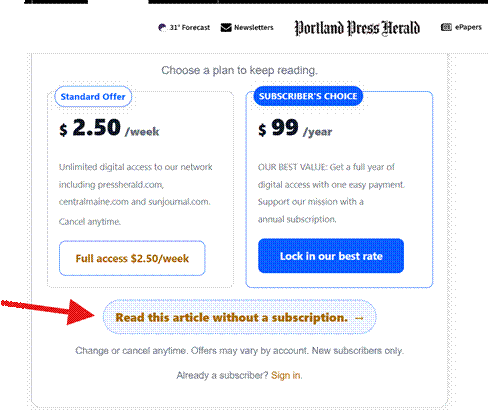
It’s not a model that seeks to replace subscriptions, rather it attempts to supplement them by capturing revenue from casual readers, giving choice to the 99% who otherwise are going to walk away.
But underneath its apparent simplicity lie deeper questions: Does it impact subscription revenue? Why should the industry take this iteration of micropayments more seriously than any that came before? What trade-offs does it introduce for publishers and readers?
Background Context: Paywalls and Walkaways
The vast majority of readers hit a paywall and simply leave. According to a Pew Research Centre study, 83% of U.S. adults say they did not pay for online news in the past year, and just one percent said they pay when they encounter a paywall. Meanwhile, other surveys show that 58% of users actively try to bypass paywalls, and 68% avoid clicking links from known paywalled sites entirely.
MarketWatch sums up the research, “Many major news outlets have had difficulty creating meaningful businesses through online subscriptions.”
These stats expose the limits of binary subs models. Publishers convert just 2–5% of their audience into paying customers, leaving upwards of 95% of users outside the monetisation funnel. Yet for casual readers who arrive via social media, search, or news aggregators, a full subscription is disproportionate to their intent.
Some publishers are now testing new approaches that let users pay for temporary access rather than long-term commitment. One of those experiments is Supertab, currently in beta with a number of U.S. publishers.
After successful trials it’s now live inside Google Ad Manager, powered by a running tab that makes it effortless to buy single articles, time passes or even prompt packages that create a natural pathway to a subscription.
“People want content - they just don’t want the lock-in. We all have our one or two subscriptions we really love. Everything else? It’s a no-no.” Cosmin Ene, CEO, Supertab.
The story is global: rising user expectations, a worsening cost of living crisis, and persistent inflation are all converging to weaken the appeal of traditional paywalls. As discretionary income tightens, even modest digital subscriptions become harder to justify, especially for one-off or occasional reads.
How It Works
Supertab integrates into a publisher’s existing paywall system. When a reader encounters a locked article, they are first shown a subscription offer. If they decline, Supertab appears as an alternative, offering timed access such as one hour, one day, or one week. The reader clicks to accept and the content unlocks instantly.
To get a tab, they simply sign in with their Google account. Each purchase is added to the user’s personal Supertab.
This tab can accumulate across multiple publishers, and the user settles the balance periodically, much like a utility bill. Some users might carry a balance of $5, others $30 or more, depending on how often they use it.
People pay after 30 days or whenever the tab reaches a certain threshold, through stored payment details, ensuring continuity without added friction. This model allows readers to pay only for what they consume, while giving publishers a seamless way to recover revenue from otherwise lost engagements.
Micropayments Reframed, But Not Resolved
Supertab isn’t the first company to try micropayments. Blendle, the Dutch platform once hailed as a breakthrough model, failed to gain traction despite early promise. The key difference now, Ene argues, is that Supertab doesn’t replace subscriptions, rather it augments them. Additionally, Supertab integrates itself seamlessly into the publisher’s ecosystem, instead of being an app, a wallet, or an independent brand chasing publishers’ customers.
At Portland Press Herald, the Maine publisher which has successfully trialed the technology, Supertab appears below the standard subscription call-to-action. Readers not ready to subscribe are offered timed access: one hour, 24 hours, or a week.
“It’s not a replacement for the paywall. It’s giving people choice instead of sending them away.” Cosmin Ene, CEO, Supertab.
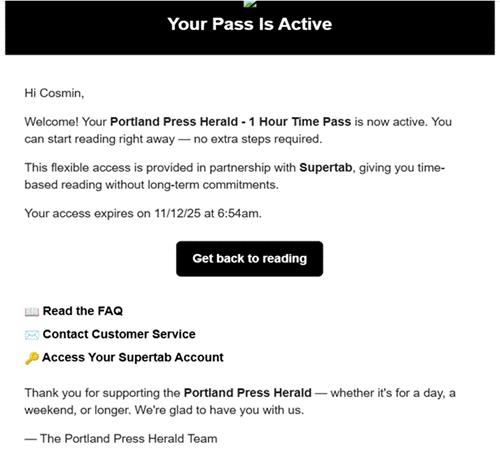
This repositioning from disruptive alternative to friction-reducing complement is the missing link. By offering an exit path rather than a dead end, publishers can still extract value from readers who would otherwise bounce.
Furthermore, when a user cancels a subscription, publishers can offer a fallback: continue reading, just pay as you go. It offers a powerful retention framework.
Final Thoughts: Promise or Placeholder?
According to Ene, many publishers are often asking the wrong question: “How do I make more money with subscriptions?” Ene argues that the right questions are: “How do I make money online, regardless of which products I’m combining to compound revenue? How do I monetise casual readers without turning them away?”
In a landscape dominated by adblockers, content scraping, and fleeting attention spans, giving users more ways to say yes, even small ones, could be the biggest win of all in 2026.
And as publishers like the Portland Press Herald are finding, “We’ve seen time pass users convert to subscriptions - and that’s great. But I think the real value is in the UX,” says Matt Fulton, Chief Audience Officer at Portland Press Herald.
“We are creating low barriers to entry for access to our vital local stories. And we are giving readers a choice. I think that will pay off in the long game of creating positive brand associations with our potential future subscribers.”
It holds promise.