

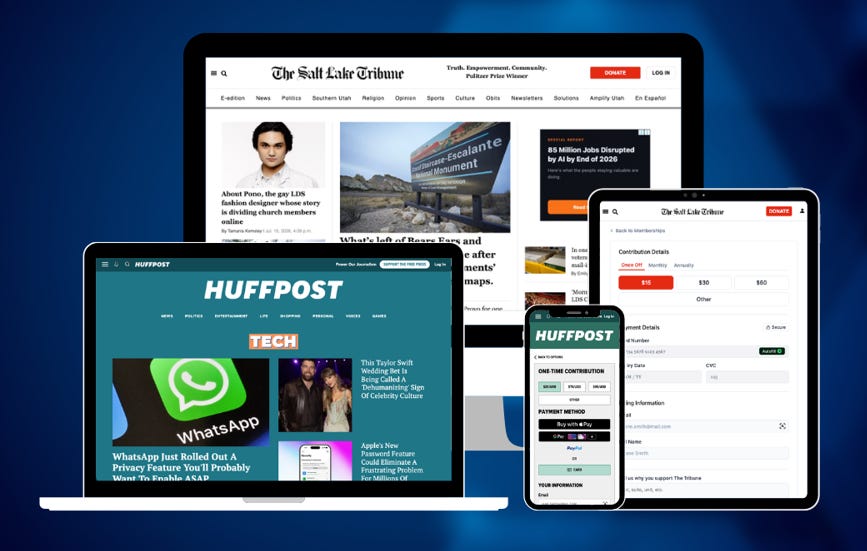
As more publishers test voluntary contributions alongside subscriptions, the lesson from titles including The Salt Lake Tribune, HuffPost and The Guardian is clear: reader support only works when the payment request is tied to mission, identity and a strong perceived value exchange.
Paul McCarthy-Brain, CEO of reader revenue platform Flip-Pay, has worked with contributions-based publishers including HuffPost and The Salt Lake Tribune. His view is that too many publishers still treat donations as an add-on payment option, when the real work is in explaining why support matters before the reader is asked for money.
He also emphasises that implementing a voluntary contribution model demands as much commercial discipline as a subscription model, requiring just as much product thinking, data capability and retention work. The key difference is that the transaction is framed less as a content purchase and more as a relationship with a publication’s purpose.
“The key is bringing the reader along with you,” he told me. “You have to communicate your mission, and why their support matters; make them feel they’re making a difference and show the value their contribution creates.”
Mission Is the Product: Reader Support Has to Start With Purpose
The Guardian remains the clearest example of mission-led giving. “Their donations are based on consistent messaging, which states that when you donate, you’re supporting their independence, free from political influence and the whims of billionaires,” says McCarthy-Brain. “It works because it’s true to who they are. You couldn’t simply apply that messaging to every publisher.”
A more recent example is The Salt Lake Tribune. After becoming the first legacy newspaper in the US to transition to non-profit status, it dropped its paywall this year, making its content free to access online. Rather than reframing donations as an alternative payment method, it now positions them as preserving access to journalism that might otherwise not survive.

“The Tribune believes that its reporting should be available to everyone because reliable information is becoming harder to find, and access to trustworthy news matters,” says McCarthy-Brain.
“Before lowering their paywall, they conducted reader research and found that 87% of subscribers surveyed were happy to continue paying, even when content was made free,” he says. “Readers understand why they’re being asked to contribute because the publication has a very clear mission.”
The HuffPost Tests the Same Logic Differently
Another publisher that McCarthy-Brain works closely with is HuffPost, and whilst it remains a for-profit title, the publisher has been operating a voluntary donations model since 2023. Its pitch? Inviting readers to join a ‘community’ of like-minded people who believe journalism should serve the public good.
“The way they position it is that, by donating, you’re not just funding journalism, you’re standing alongside thousands of supporters who value fairness, clarity, and accountability,” says McCarthy-Brain.
For publishers presenting a clear vision, donations become more than a payment mechanism, and become a way for readers to actively support values they believe in. The commercial test then becomes whether voluntary support can survive beyond a single donation and turn into repeatable income.
All three of the aforementioned publishers have gone beyond a simple ‘donate’ request, and developed tiered membership models, which include incentives for different levels such as ad-free experiences, exclusive newsletters, events and merchandise.
Membership becomes a particularly strong middle-point as they’re effectively voluntary subscriptions repositioned into a sense of belonging. “Publishers enjoy the regular income, and readers are given a choice about how they want to support you,” he says. “Those supporters enjoy a sense of belonging and can often become more loyal than someone who’s feeling compelled to cough up because they’re hitting a paywall.”
Having a membership proposition also gives a clear reason for regular communication that helps further nurture the reader connection, such as email updates on how their donation is being spent, invitations to insider events, or early access to certain content or opportunities.
McCarthy-Brain points to behavioural economist Rory Sutherland’s advice that small signals of belonging can have an outsized impact on loyalty. “Something as simple as telling someone, ‘You’ve been a member since…’ reminds them they’re part of something bigger,” he says.
Giving Readers a Choice
While publishers like the Guardian, the Salt Lake Tribune and HuffPost are relying on donations and memberships as their primary reader revenue models, McCarthy-Brain doesn’t believe subscriptions are disappearing, nor does he expect donations to work for everyone.
Premium publishers such as the Financial Times or The Wall Street Journal will continue to thrive behind paywalls, he says. Other organisations, particularly local and mission-led publishers, and non-profits looking to remain independent, may find greater success by keeping journalism open and encouraging voluntary support.
Increasingly, however, he expects to see the distinction between subscriptions, memberships and donations become less important than the overall reader relationship. Publishers should focus less on persuading people to pay for content, he says, and more on giving readers reasons to support quality journalism, with a portfolio of options.
“The most successful publishers won’t rely on a single revenue model,” he says. “They’ll understand their audience, communicate their value clearly and give readers different ways to support the journalism they care about.”